ADHD & Autism

Neauroaffirming Assessments across the lifespan.


How we assess ADHD and Autism in children and adults

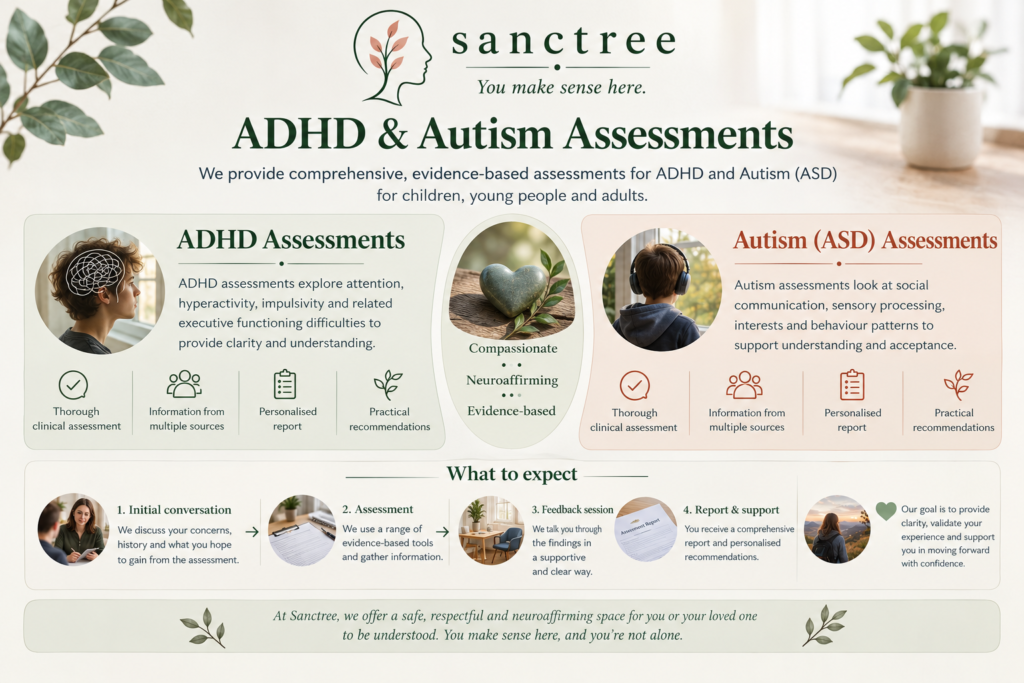
ADHD and Autism assessments are approached with the same care and attention whether you’re a child, adolescent, or adult. Each assessment takes time to understand the full picture: clinical interviews, behavioural observations, standardised questionnaires, and cognitive testing all play a part, alongside tailored tools including the DIVA-5 for ADHD and ADOS-2 for Autism. The aim is to reach a thorough, evidence-based diagnosis, but also to leave you with recommendations and guidance that actually make sense for your life, not just a report. Every step of the process is grounded in a neuroaffirming approach, because understanding how your mind works should feel supportive, not clinical and cold.


ADHD Assessments
ADHD affects an estimated 3–4 % of adults and around 5 % of children and young people, with up to 2.5 million individuals thought to live with the condition in England alone [NHS England, 2025; NICE].
ADHD Assessments

AUTISM Assessments
Research suggests around 1 % of the adult population meet criteria for autism spectrum disorder based on assessments such as the ADOS [Brugha et al., 2011].
Autism Assessments

Combined ADHD & AUTISM Assessments
It is important to understand the complex overlap between ADHD and Autism (AuDHD). It’s common for individuals with ADHD to exhibit autistic traits, and vice versa, or for both conditions to co-exist.
Combined ADHD and Autism Assessments
Understanding Repetitive Movements
Stimming (hand-flapping, rocking, finger-tapping, leg-shaking, or twirling objects) is a common and natural way many autistic and ADHD people self-regulate. Recognising this helps create spaces where people feel comfortable being themselves.
ADHD and Autism, understanding repetitive movements
Understanding Social Challenges
Living with AuDHD can make social interactions challenging. Many feel isolated or struggle to form and maintain friendships, which can affect confidence and a sense of belonging.
ADHD and Autism, understanding social challenges
Understanding Emotional Regulation
Emotional ups and downs are common, including mood swings, anger, or sensitivity to criticism. Recognising and managing these challenges is key to building coping skills and wellbeing.
ADHD and Autism, understanding emotional regulation
autism & adhd assessments

Find Us

Online, Manchester & Cheshire

Make An Appointment

Take the First Steps

Contact Us

We're Here to Help